If You've Never Touched SAP OData - Read This First
OData is how SAP exposes data to the outside world. Think of it as SAP's API layer - it lets you read, create, update, and delete business data over HTTP without touching ABAP or going anywhere near the database.
The catch: there are two versions. OData V2 has been around forever and powers most on-premise SAP landscapes. OData V4 is what SAP pushes for S/4HANA Cloud. They look similar on paper. In practice, they disagree on almost everything - date formats, pagination, filter syntax, response structure.
If you already know all this, skip ahead. If you don't, just know this: OData is the right way to get data in and out of SAP. It's also the reason this node needed to exist.
What is the n8n SAP OData Community Node?
It's an open-source n8n node that talks to SAP properly. Full CRUD, OData V2 and V4, service discovery, function imports, real-time webhooks. No middleware, no ABAP, no SAP BTP license. I built it because after 18 years of SAP consulting, I was tired of watching people fight with generic HTTP requests to get data out of SAP.
The gap between n8n and SAP was obvious. n8n had hundreds of integrations but nothing that understood SAP OData services - the CSRF tokens, the pagination quirks, the metadata parsing. This node closes that gap.
Why did an SAP consultant decide to build an n8n community node?
Getting data in and out of SAP has always been harder than it should be. With my experience as an SAP consultant across ECC implementations, S/4HANA migrations, functional consulting, and technical architecture, that one frustration kept coming back.
My name is Sascha Seegebarth. I started exploring n8n out of curiosity. It's open-source, self-hostable, and built for developers. Within a few hours, I had my first workflow running. Within days, I was hooked.
But one thing kept bothering me: there was no real SAP integration.
Sure, you could make generic HTTP requests. But anyone who has worked with SAP OData services knows that "just make an HTTP call" glosses over a mountain of complexity:
- CSRF tokens that must be fetched before every write operation
- SAP-specific date formats (Edm.DateTime in V2 vs standard ISO in V4)
- Pagination that works completely differently between V2 and V4
- Hundreds of available services with no way to discover them from n8n
- Compound entity keys with multiple key fields
- Filter syntax that changes depending on the OData version
With 18 years of SAP behind me, I could see exactly what was missing. And I could see how much a proper SAP node would mean for the n8n community. n8n's workflow engine with SAP's data backbone. Two worlds that had no bridge between them.
So I decided to build one.
How complex is building an OData integration from scratch?
More complex than I expected, and I've been working with OData for years. n8n community nodes don't allow external npm libraries. So everything had to be written from zero: XML metadata parsing, CSRF tokens, pagination, response normalization. All pure TypeScript.
Should I have started with a simpler node to learn the community node development process? Absolutely. Did I? No. I went straight for OData, one of the most complex protocols SAP uses, with two major versions that behave differently in almost every aspect.
That no-external-dependencies constraint shaped the entire architecture. It forced me to understand OData at a depth I'd never needed as a consultant. And honestly, it made the result better.
But the learning curve was steep. Too many commits in the early days. Lint tests that I should have run from the start would have saved me dozens of manual test cycles. Every mistake was a lesson, and there were plenty.
OData V2 vs V4 - the thing nobody warns you about
This deserves its own section because it's the part that breaks most SAP integration attempts.
People assume V4 is just "V2 but newer." It's not. They're different protocols that happen to share a name. Here's what I had to deal with:
Every single one of these differences would break a generic HTTP approach. The node handles all of them automatically - it detects the version from the metadata and adapts.
What happens when scope creep hits your own attention?
About halfway through development, something happened that's probably familiar to anyone who builds things: I got sidetracked.
Aemal shared a post about combining n8n with Replit and Pinecone for vector-based use cases. My brain immediately went: what if we combine this with SAP? Imagine vector search across SAP master data. Semantic queries against business partner records. AI-powered analysis of financial documents stored in SAP.
I was completely triggered. Three days later, I was deep into vector database architectures instead of finishing the node.
Classic scope creep, except it wasn't scope creep on the project. It was scope creep on my own attention.
That detour deserves its own post. But the short version: I had to pull myself back and finish what I started. The SAP OData node had to ship first. Everything else could come after.
What happens when SAP deprecates your demo one day before showtime?
One of the most nerve-wracking moments came right before a planned demo. I'd set up a workflow using the SAP Business API Hub, SAP's public sandbox for testing APIs. Everything was working. Clean data, smooth execution, a good demo flow.
Then, one day before showtime, the API Hub deprecated the services I was using. Shortly after, the entire platform went into maintenance mode. For days.
You sit there, stare at the screen, and wonder what just happened. All your preparation, gone because of something completely outside your control.
I had enough alternatives to pivot. But that moment? Pure frustration. And a reminder that when you build on SAP infrastructure, you're always at the mercy of SAP's timeline.
Watch the SAP OData Node in Action
Here's a full demo of the node connecting to a live SAP system, running CRUD operations, and handling real data:
How did the SAP and n8n communities respond?
When I first posted about the node on LinkedIn, I wasn't sure what to expect. SAP consultants tend to be a conservative crowd when it comes to new tooling. And n8n, while growing fast, was still relatively unknown in the SAP ecosystem.
The response surprised me.
People shared their own SAP integration pain points. They described exactly the problems I'd built the node to solve. Some reached out directly, offering to test it with their systems.
What surprised me most: both n8n and SAP noticed. The n8n team reached out and offered support for the community node development and verification process. That kind of backing from the platform told me this wasn't just a side project anymore.
How did the partnership with avanai come together?
Through the project, I connected with Aemal and avanai. From the first conversation, it was clear we thought about SAP automation the same way: pragmatic, focused on what actually works in production rather than what looks good in a slide deck.
Aemal pushed the node forward on architecture decisions and edge cases that only someone with production SAP experience would think of. API design choices, error handling, the kind of stuff that separates a demo from something you can actually run in a real environment.
That collaboration turned into a partnership. The node is now maintained under the avanai umbrella, and it's the first piece of a larger goal: making SAP accessible to the automation and AI ecosystem.
What can the SAP OData node do today?
Full CRUD, both OData versions, service discovery, function imports, webhooks, and the reliability features you need for production.
Full CRUD support. Create, read, update, and delete operations across any SAP entity set: Business Partners, Sales Orders, Materials, Financial Documents, and more.
OData V2 and V4. The node auto-detects the protocol version and handles all the differences. Date formats, filter syntax, pagination mechanisms, response structures. You configure your query once, and the node adapts.
Dynamic service discovery. On on-premise SAP systems, the node reads the SAP Gateway Catalog and presents available OData services in a searchable dropdown. I haven't seen this done properly anywhere else, including the SAP Business API Hub.
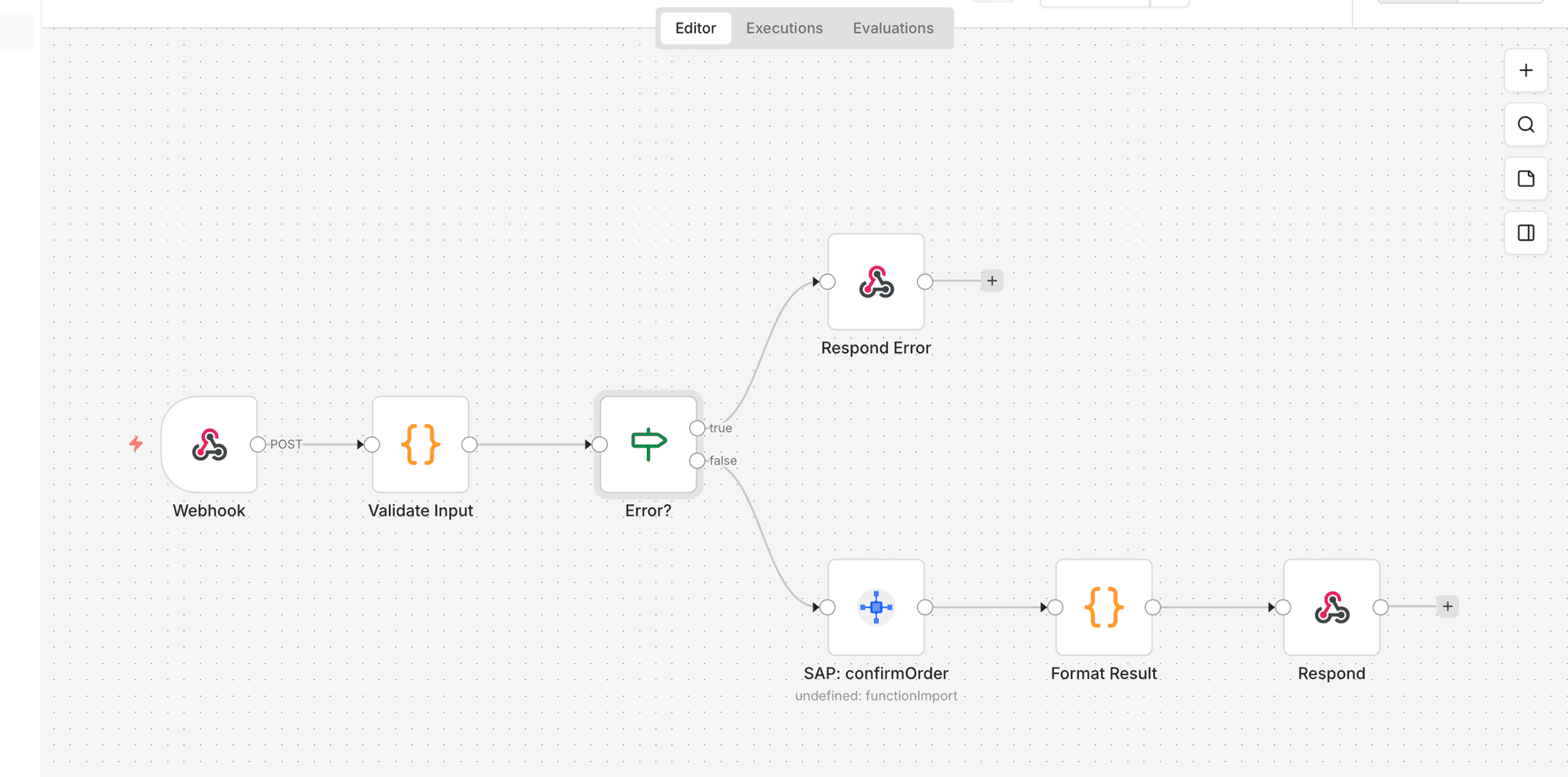
Function Imports, Actions, and Functions. Execute SAP business logic directly from n8n. Release orders, post goods movements, trigger calculations. This goes beyond just reading data - you can actually drive SAP processes from a workflow.
A real-time trigger node. Receive webhooks from SAP when data changes, with HMAC authentication, rate limiting, and IP whitelisting for production use.
Built for production. Automatic CSRF token handling, retry with exponential backoff, request throttling, and automatic pagination. The stuff that makes the difference between a demo and a system you can actually rely on.
What comes after OData? The RFC challenge.
OData covers a lot of SAP integration scenarios, but it's not everything. The next goal is RFC and BAPI call support, the backbone of SAP's internal communication for decades.
This is where it gets tricky.
n8n currently doesn't support external native libraries in community nodes. And SAP's RFC SDK is licensed in a way that prevents bundling it into open-source packages.
So I'm taking a different route. Instead of calling RFC directly from the node, I've built an HTTP-to-RFC wrapper that runs on the SAP system itself. It exposes RFC and BAPI calls through a REST-like HTTP interface, which the n8n node can then consume like any other API.
The wrapper is still in active development, but the architecture works. It means that even without the RFC SDK, n8n users get access to thousands of BAPIs and function modules that aren't available through OData. Combined with the OData node, that covers pretty much everything you'd need to integrate with SAP - modern APIs and legacy interfaces alike.
Why does open-source SAP integration matter?
SAP holds the most critical business data for hundreds of thousands of organizations worldwide. But that data has been locked behind expensive middleware, complex ABAP development, and proprietary integration platforms for way too long.
The n8n SAP OData node is a step toward changing that.
Anyone with an n8n instance and SAP credentials can build real automations: reading data, writing back, executing business logic, reacting to events. No ABAP. No middleware. No SAP BTP license. No vendor lock-in.
It's open-source, MIT licensed, and actively maintained.
Help us make it production-ready
Install the node. Connect it to your SAP system. Run it against your services. And when something doesn't work, tell me about it. Bug reports and edge cases are what make this thing better.
Want to talk about how n8n and SAP can work together in your organization? Let's talk.
Frequently Asked Questions
What is SAP OData and why does it matter for integration?
OData is how SAP exposes business data over HTTP. It lets external applications read, create, update, and delete SAP data without ABAP development. Two versions - V2 (on-premise) and V4 (S/4HANA Cloud) - that differ in date formats, pagination, filters, and response structure.
Does the node work with both on-premise and cloud SAP systems?
Yes. S/4HANA, ECC, BTP - anything that exposes OData services. On-premise systems also get dynamic service discovery through the SAP Gateway Catalog.
Do I need ABAP skills to use the node?
No. The node handles CSRF tokens, pagination, and protocol differences automatically. You configure your connection in n8n's visual interface and build workflows without code.
How do I test SAP OData services without Postman?
With Postman, you manually handle CSRF tokens, date formats, and pagination for every request. The n8n node does all of that automatically. Install it, configure credentials, pick a service from the dropdown, and run operations.
Is the node ready for production use?
It has automatic retry with exponential backoff, CSRF management, request throttling, and HMAC-authenticated webhooks. But test thoroughly in your environment first. Every SAP system is different.
Do I need to create OData services in SAP first?
Most S/4HANA and modern ECC systems already have OData services activated. The node discovers them automatically via the Gateway Catalog. Custom services are built in SEGW (V2) or ABAP RAP (V4).
What is the difference between OData V2 and V4?
V2 uses XML by default, SAP-specific date formats, and server-driven pagination. V4 uses JSON, ISO 8601 dates, and client-driven pagination. They also differ in filter syntax, batch requests, and business logic calls. The node detects the version automatically.
Can the node call SAP BAPIs and RFC function modules?
Not directly through OData. But an HTTP-to-RFC wrapper is in development that runs on the SAP system and exposes BAPIs through HTTP - giving n8n access to thousands of function modules without the RFC SDK.
How do I integrate SAP data with n8n without middleware?
Use the open-source SAP OData community node for n8n. It provides full CRUD operations, OData V2 and V4 support, dynamic service discovery, function imports, and real-time webhooks - connecting n8n directly to SAP without middleware.
Want to automate your SAP processes with n8n? Get in touch and let's figure out what makes sense for your setup.